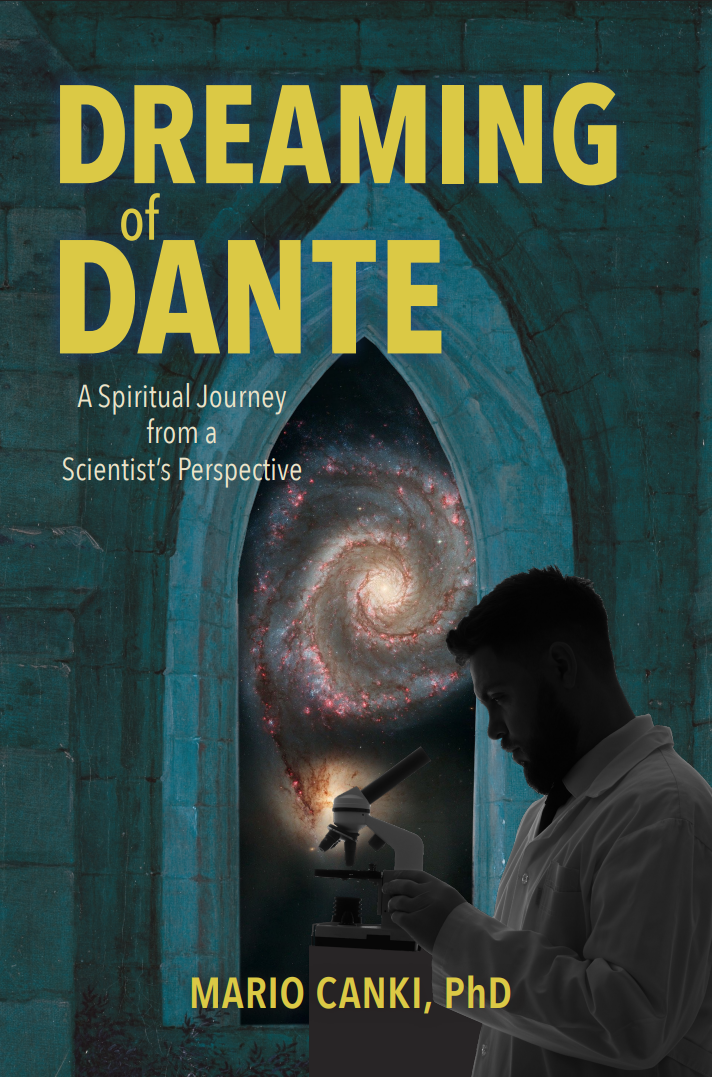
Dreaming of Dante

A lived account of inquiry — scientific and spiritual — converging in one life

Dreaming of Dante is written for the seeker who refuses to choose between science and spirituality.

A persistent discontent — first felt in adolescence and later sharpened during years on Wall Street — became the quiet engine of my life’s inquiry. Professional success did not resolve the question of meaning; it clarified it.

From that unrest emerged two disciplines: the rigorous study of the sciences and the disciplined search for interior stillness. What appeared at first as parallel pursuits — one scientific, one contemplative — gradually revealed themselves as expressions of the same inquiry. The answers unfold slowly, through experience rather than argument. What emerges is that the reconciliation of intellect and spirit is not only possible, but necessary. 

Using Dante Alighieri’s Divine Comedy as its guiding architecture, the book unfolds along the arc of descent and ascent: confusion, purification, integration. Dante’s mountain becomes both symbol and lived terrain — a map traced not in abstraction, but in experience.

The Science

How do we determine objectivity of the spiritual experiences of unity or oneness reported by people in meditative state? Neuroimaging research shows that deep contemplative or spiritual experiences alter the brain activity in measurable ways.

In particular, the brain region involved in spatial awareness and in our sense of self, shows decreased activity. When this region quiets, the usual boundaries that define us – and our separateness from the surrounding world, begin to dissipate.

Our brain normally relies on this region to orient us in the physical space and to maintain a clear distinction between ourselves and the external environment. When this activity diminishes, that boundary can temporarily disappear, giving rise to a profound feeling of transcendent unity with something larger than oneself.

Consider this in the context of Dante’s journey. When the Pilgrim reaches the summit of the mountain, he encounters Beatrice—his higher self—and experiences a mystical union that transcends his ordinary identity.

Empirical research shows us that the human brain possesses innate capacity to enter metaphysical states of oneness. In this sense, modern science has caught up with, and has empirically validated, the mystical experiences which sages, poets, and philosophers have described for millennia.

Additional information

Book Type

Paperback

Category ,
Tags , ,
SKU B0GNTPXL9Z

Reviews

There are no reviews yet.

Add a review

Your email address will not be published. Required fields are marked *


Dr. Canki’s reflections speak to the doubts and discoveries that arise for anyone exploring the deeper dimensions of life.


Richard Schaub, PhD Author of The End of Fear: A Spiritual path for Realists